
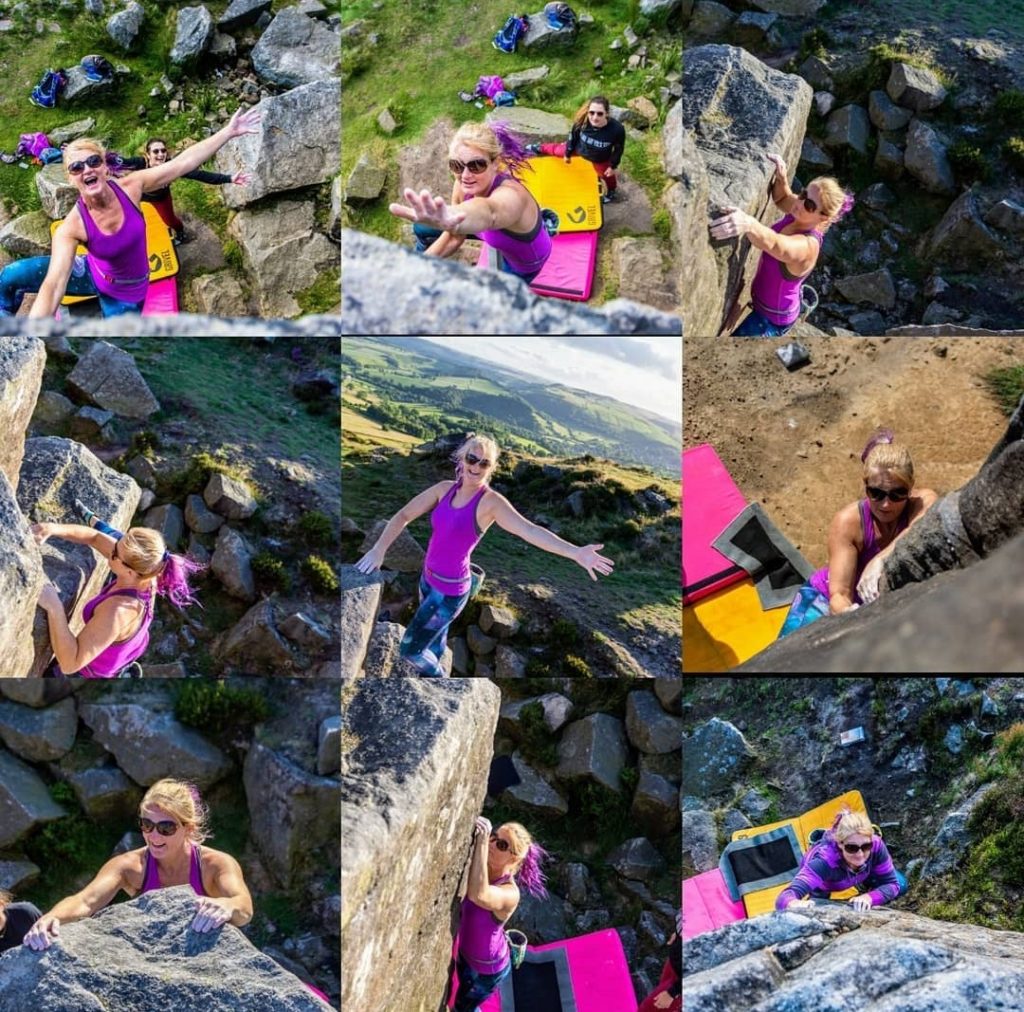
Healing Waters began years ago inside the climbing world that shaped so much of Rebecca’s life. This Healing Waters recovery story starts with climbing, injury, identity, and our refusal to accept that recovery had reached its limits.
What started as a climbing-centre repetitive strain injury, followed by failed surgeries and a long fight for answers, slowly evolved into something far bigger: a recovery journey through wild swimming, remote water, and intentional healing in nature.
Rebecca’s Life in Climbing
Rebecca has always been deeply active. Movement has never simply been exercise for her—it is part of who she is.
Years ago she visited New Zealand and watched some people climbing outdoors and was fascinated. She loved it and wanted to do it herself. She soon found a climbing centre, surrounded herself with other climbers. Developed her skills outdoors and indoors and pursued the Climbing Wall Instructor, Climbing Wall Development Instructor, Rock Climbing Instructor qualifications as well as attending numerous courses to enhance her skills such as the FUNdamentals series.
Rebecca was sort after. She was the first female climbing instructor in the area. The all female indoor coaching group she started at her first climbing wall is still going strong, and despite years passing the format and warm up routine are still the same, surviving the test of time. Rebecca is still in touch with many of the ladies who attended her sessions.
Her years working in climbing centres, teaching, supporting others, and moving on the wall herself have always carried something beautiful. I remember belaying her as she was lead climbing at an indoor wall and a young girl who was watched commented to her mum, “Mum, mum, look at that lady. It’s like she’s dancing up the wall!” And that summed it up. The quality in the way she climbs: fluid foot placements, effortless balance, graceful shifts of weight, every move linked to the next with calm precision, a perfect flow.
Climbing has always been part strength, part expression, part identity.
How the Climbing Injury Happened
And it was within that world that the problem began.
At another climbing centre, a huge amount of the daily operational load fell onto Rebecca through repeated “bell ringing”—the rope and climber management system used predominantly for children and introductory sessions or early NICAS sessions. It allows multiple climbers to be managed at once whilst the instructor controls perhaps two lines per hand. At this climbing wall there were times an instructor had to manage three lines per hand at a time.
Unlike church bell ringing, this is not a leisurely occasional pull on a Sunday morning.
This was constant, repeated, forceful rope handling through long shifts, again and again, day after day.
The same movement pattern.
The same grip.
The same tendon loading.
The same forearm pathway under tension.
In busy centre environments, especially when this responsibility disproportionately sits with one person (she was regularly given the larger groups to handle, because she was capable, right or wrong), the cumulative load becomes enormous.
Over time, that repetition caused significant tendon overuse and repetitive strain.
At first it seemed manageable.
Something that would rest.
Something temporary.
Something that would improve with time.
But it didn’t.
The symptoms worsened, affecting not just climbing but everyday movement and the way we were able to deliver activities. Rebecca managed it by strapping it up, changing where the load sat, plus she shifted her work patterns and admittedly the centre learned too, limiting the number of lines an instructor could handle. But, the damage was done.
The Failed Surgeries and Fight for Answers
There followed the long wait for surgery.
Hope built around the idea that once the tendon was repaired, things would return to normal.
The first surgery failed. Not because they couldn’t go in and do what they intended (Rebecca now has an artificial tendon in her right forearm). No, the surgery somehow damaged her ulnar nerve.
The pain worsened.
The weakness grew, not improved. Muscle started to waste away.
The frustration intensified. Anger festered. Rebecca had to fight to get it looked at as the surgeon insisted he’d done nothing to cause any additional damage.
A second surgery followed, bringing renewed hope, but again the recovery never delivered the improvement we had fought for.
Rebecca, once again, had to push hard for proper nerve conduction testing, convinced there was more happening than had first been recognised. Twice she found herself in the exhausting position of having to fight for answers while trying to stay positive. She’s still waiting on the nerve conductor test after the 2nd surgery as I write this (6 months on).
As time went on, the way we worked had to change.
Rebecca hadn’t climbed for 18 months.
Rebecca hadn’t paddle-boarded for over two years.
I delivered all activities through SR Exploranza, whilst Rebecca just watched from home.
For someone whose life has always been rooted in movement, challenge, and the outdoors, this was not simply an injury.
It was a challenge to identity.
This part of the Healing Waters recovery story was the hardest, because it forced us to question what recovery could really mean.
How the Healing Waters Recovery Story Began
There were moments where it felt as though this might simply be the outcome we were expected to accept.
That this was now life.
But neither of us was willing to accept that.
Healing Waters was born from that refusal. A refusal to let pain dictate the edges of life. A refusal to believe that recovery could only be found in clinical spaces. A refusal to surrender the outdoors that has always been central to who we are.
Why Water Became the Answer
The next chapter of the Healing Waters recovery story came through cold water, remote places, and the outdoors Rebecca has always loved.
Water kept calling us back. Rebecca loved water, paddleboarding (too much strain on her hand). Scuba diving (we intended to try this in Egypt but soon realised Rebecca wouldn’t be able to haul herself back into the boat. Snorkelling, yes, this worked, but even in Egypt her right hand would get cold very quickly.
We loved the outdoors. Rebecca loved the outdoors. She loved water. Even at a spa day Rebecca would search for the cold shower, the ice bucket, the plunge pool. How could we use this?
Cold water.
Remote water.
Pools and lakes that required effort to reach.
Places where the body could move differently.
Places where the nervous system calmed.
Places where healing felt possible.
The Next Chapter in the Healing Waters Recovery Story
Healing would not come from waiting.
It would come from intentional action.
That is how Healing Waters was formed.
Not from a marketing idea.
Not from a challenge concept.
But from lived experience, resilience, and the refusal to stop searching for what recovery could still look like.
Tomorrow, the Healing Waters recovery story moves from reflection into action.
Follow our journey as we share the first Healing Waters swim and the lessons it brings.
Leave a Reply